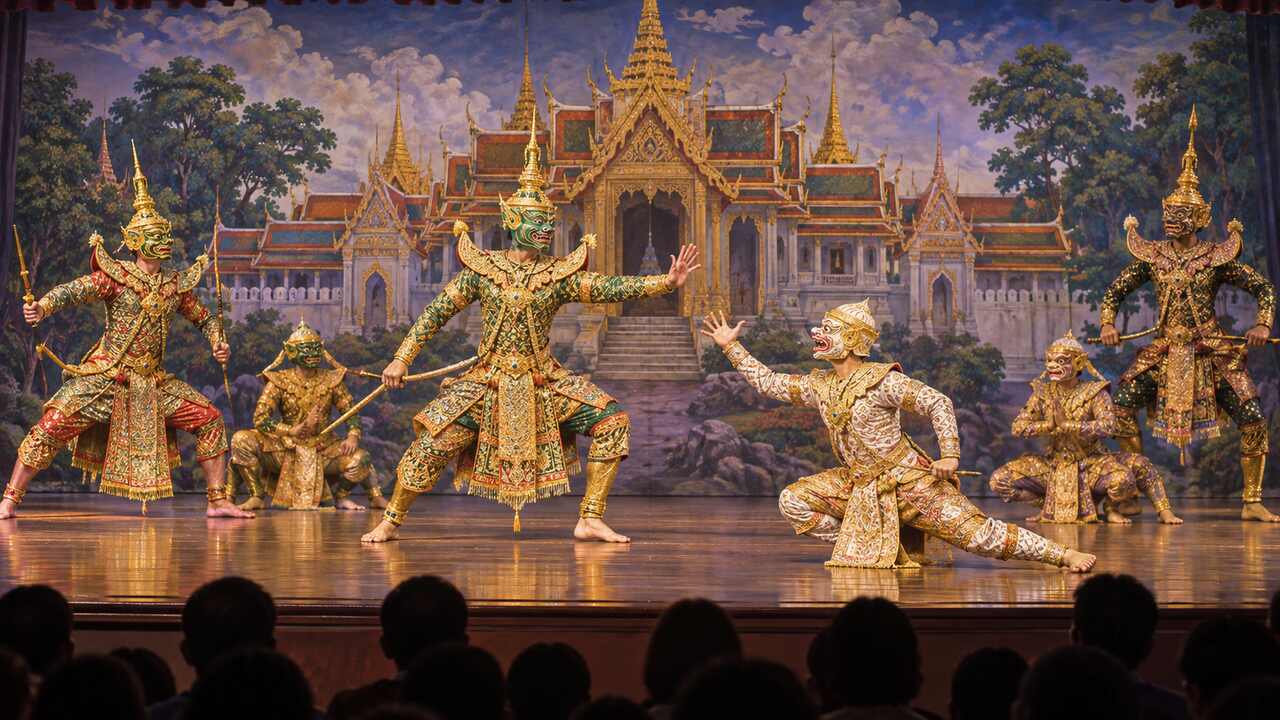
In short: Khon is Thailand’s masked dance drama. Dancers in masks and court-style costumes act out episodes of the Ramakien, the Thai version of the Ramayana, to a piphat orchestra, with narrators and singers telling the story. It began in the royal court, dates back at least to the Ayutthaya period, and in 2018 became Thailand’s first element on UNESCO’s Representative List of the Intangible Cultural Heritage of Humanity. Visitors can see it most days in Bangkok.
Khon is the grandest form of Thai classical dance. It brings together movement, masks, costume, music, poetry and painted scenery to tell one long story, the struggle between Phra Ram (Rama) and the demon king Thotsakan for the princess Sida. For centuries it was performed only for the court. Today it is taught in schools, staged in national theatres and shown to visitors in short daily performances in Bangkok.
This guide explains what khon is, where it came from, how the masks and music work, how it is kept alive, and where you can watch it. It sits alongside our overview of dance styles and history and our list of America’s Irreplaceable Dance Treasures, because heritage dance survives in very similar ways across the world.
A few terms first. The Ramakien is the Thai version of the Indian epic the Ramayana. Phra is the hero role, nang the heroine, yak the demon and ling the monkey. The piphat is the ensemble of xylophones, gongs, drums and oboe that plays for khon. A khon “episode” is a section of the epic staged as a single evening.
What is khon masked dance drama?
UNESCO describes khon as a performing art that combines dance, music, vocals, literature, dramatic arts, ritual and handicraft. Its stories come from the Ramakien, which follows Rama, his army of monkeys and his war against Thotsakan and the demons. Performers do not speak. Narrators and a chorus deliver the text, while dancers express each character through set gestures and postures, and the orchestra marks every entrance, fight and emotion.
Each role type has its own way of moving. Demons stand wide and stamp; monkeys crouch, scratch and leap; heroes and heroines move with controlled, curving hands and slow, balanced steps. The vocabulary is learned over years, and a trained audience can read a character’s mood from the angle of a wrist.
Where khon comes from
The Ramakien has been part of Thai heritage since the Ayutthaya period (1351 to 1767), according to Thailand’s Royal Society, and the Tourism Authority of Thailand dates khon itself to the same era. It grew from older court traditions, including shadow puppet theatre, martial arts and ritual dance, and it was performed for royal ceremonies and state occasions.
Change came in waves. Women were allowed to take part under King Rama IV in the nineteenth century. After the end of absolute monarchy in 1932, court patronage declined and khon moved to state institutions, chiefly the Fine Arts Department and its schools. Thailand’s Department of Cultural Promotion declared khon national intangible cultural heritage in 2009.
On 29 November 2018, meeting in Port Louis, Mauritius, the UNESCO committee inscribed khon on the Representative List of the Intangible Cultural Heritage of Humanity. It was Thailand’s first inscription, two years after the country joined the 2003 Convention. Thai massage, nuad Thai, followed in 2019 and the southern dance drama nora in 2021.
Masks, costumes and characters
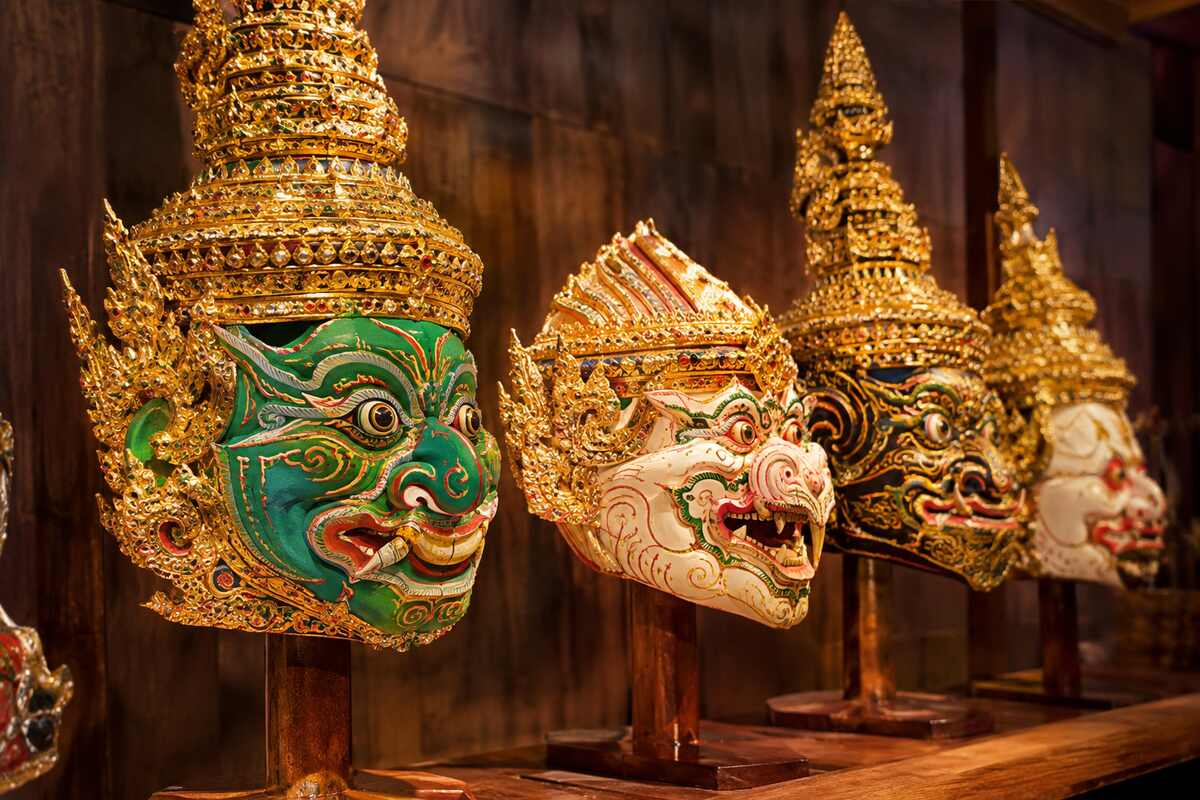
The masks are the most famous part of khon. Traditionally they are made of papier-mâché built up over a mould, then coated with lacquer, painted and decorated with gold leaf and glass mosaic. Colour and crown shape identify the character: Thotsakan is green with a many-tiered crown of faces, Hanuman the monkey general is white, and each demon and monkey has a fixed colour scheme. In early khon all performers were masked. Today the heroes, heroines and deities usually perform with bare faces and tall gilded headdresses, while demons and monkeys keep their masks.
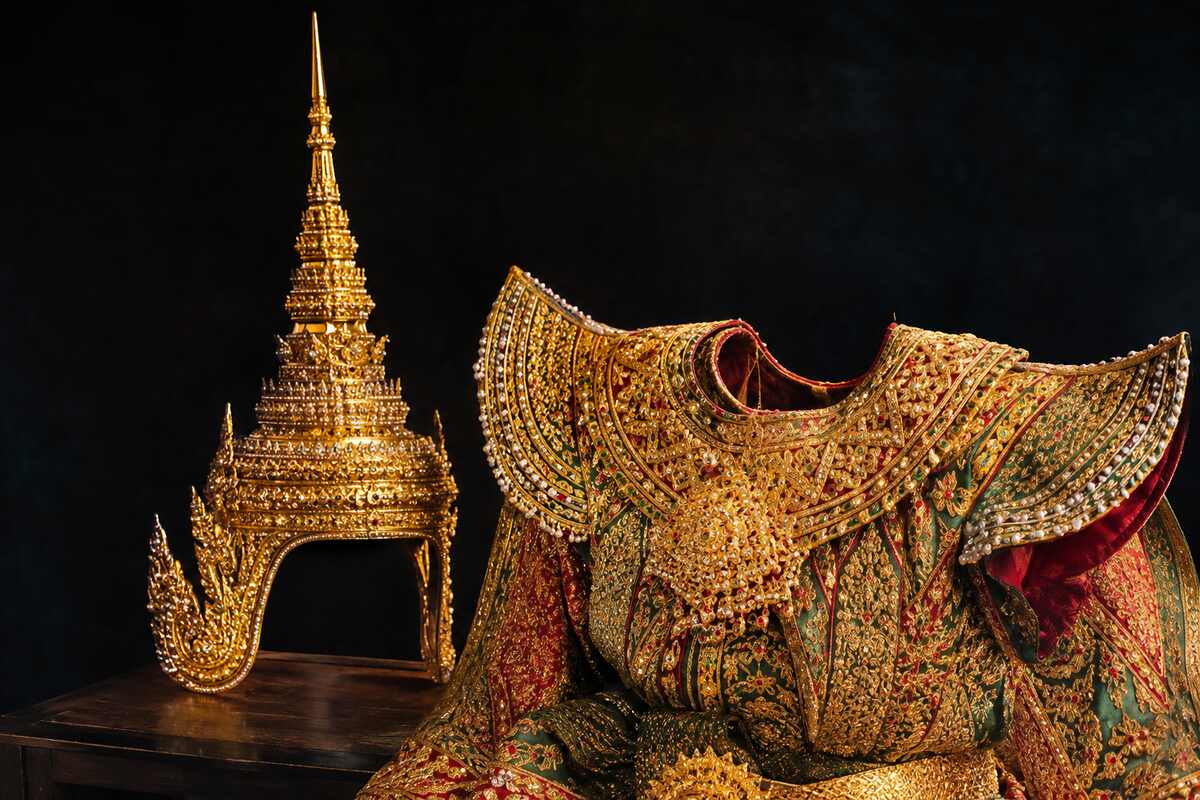
Costumes copy the dress of the old court. Jackets and trousers are heavily embroidered with gold thread and sequins, and in many productions the dancers are sewn into their costumes before each show, which is why changes between scenes take time.
Music, narration and stagecraft
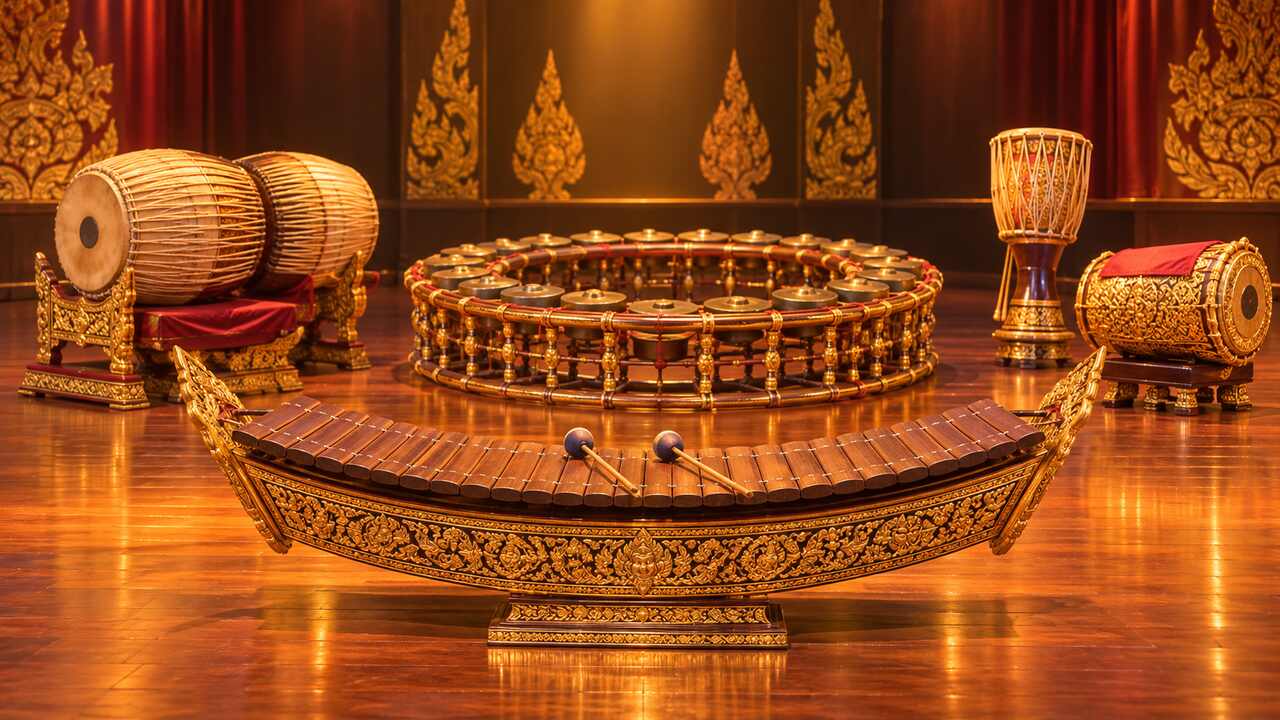
A piphat ensemble plays throughout. Particular melodies signal particular actions, such as marching, flying, weeping or preparing for battle, so the music works almost like stage directions. Narrators chant the verse, and a chorus sings the lyric passages. Large productions add painted scenery, smoke, flying effects and moving sets.
Bangkok’s daily khon shows also fold in related arts. The programme at Sala Chalermkrung includes scenes inspired by the Churning of the Milky Ocean, shadow play and krabi-krabong, the Thai art of sword and staff fighting, so visitors see how khon connects to the wider family of Thai performance.
How khon is kept alive
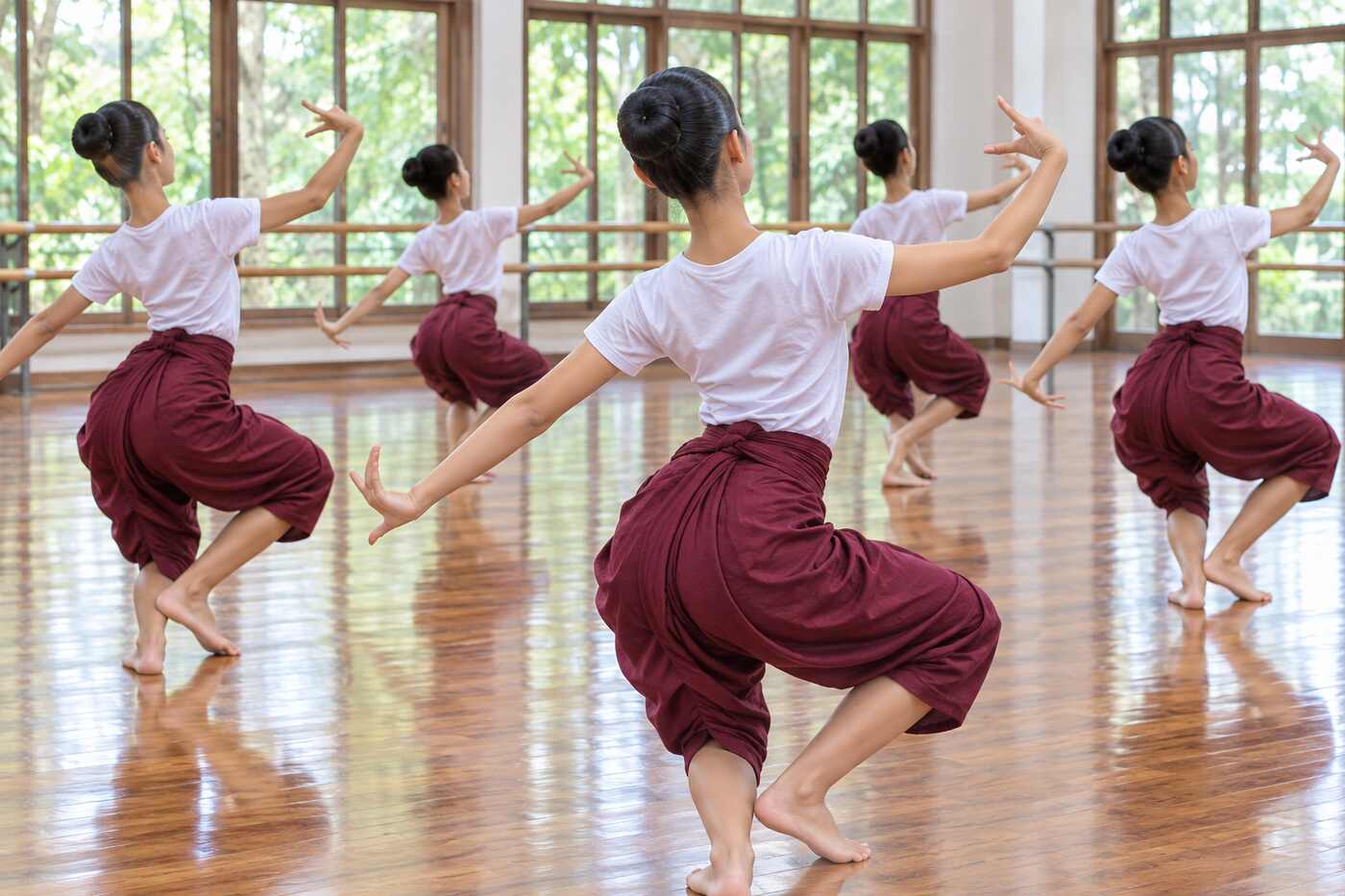
UNESCO notes that khon is now transmitted mainly through educational institutions rather than family lineages. Thailand’s nomination file names Bunditpatanasilpa Institute and its network of twelve dramatic arts colleges as the main training ground. Students specialise early in one of the role types and train for years.
Royal patronage also matters. The SUPPORT Foundation, founded in 1976 by Queen Sirikit, began its large-scale khon productions with Prommas in 2007 and now stages a new episode most years at the Thailand Cultural Centre, with auditions open to young dancers. Its 2025 season, Bali’s Unbreakable Oath, ran from 6 November to 8 December. These productions brought new costume research, new scenery and a younger audience to the form.
The National Theatre, run by the Fine Arts Department on Soi Rachini near Sanam Luang, opened on 23 December 1965 with the khon episode Ramavatar. After a major renovation, it has announced Ramavatar again as the headline of its 2027 season.
Where to see khon in Bangkok
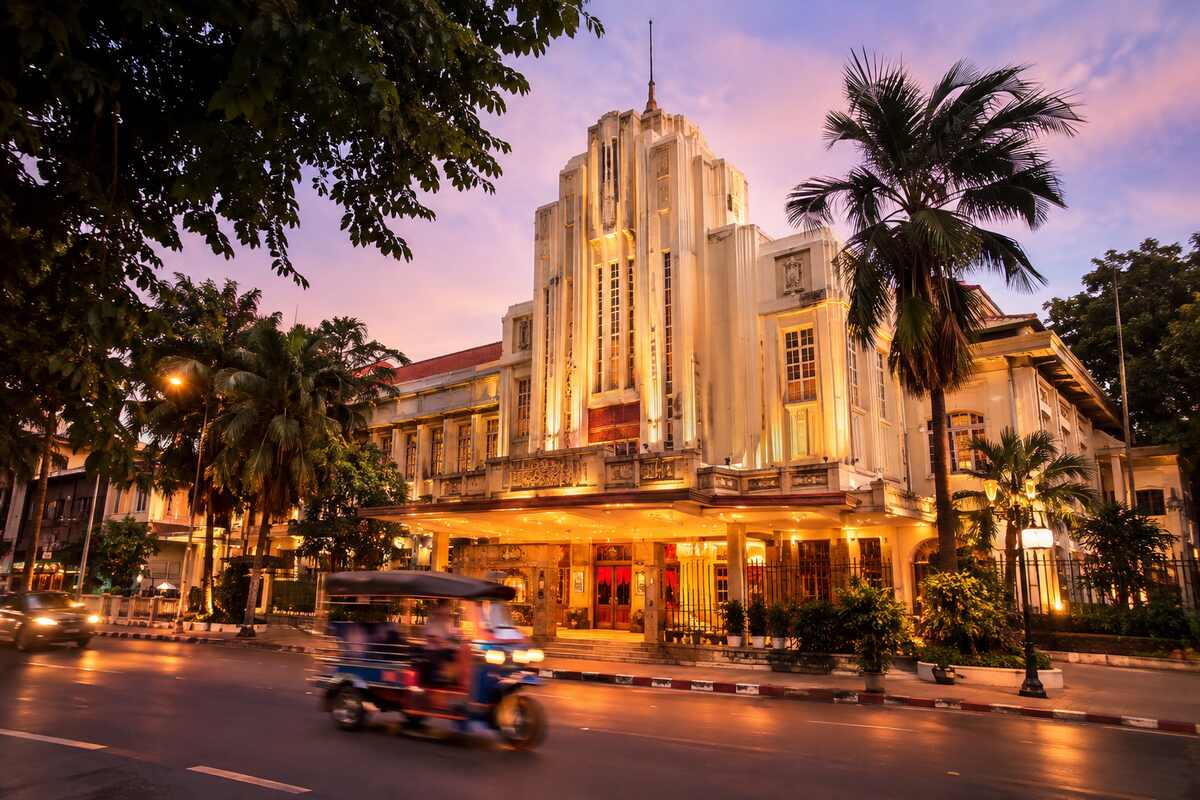
The easiest way for a visitor is the short daily show at the Sala Chalermkrung Royal Theatre, 66 Charoenkrung Road. According to the Grand Palace, 25-minute performances run Monday to Friday at 1:00, 2:30 and 4:00 PM, with English and Chinese subtitles. Holders of a foreign visitor ticket to the Grand Palace are admitted, a khon-only ticket costs 400 baht, and a shuttle leaves from the palace’s Phiman Deves Gate 30 minutes before each show. Check the official page before you go, as schedules change for holidays and royal events.
For a full evening production, look for the SUPPORT Foundation season at the Thailand Cultural Centre in November and December, or the National Theatre’s programme once it reopens. Shorter khon excerpts also appear at temple fairs, festivals and cultural shows.
Many visitors combine an afternoon of classical dance with Bangkok’s evening scene, which runs from rooftop bars and live music to large clubs. If that is part of your trip, Party Thailand keeps a current guide to the best clubs in Bangkok, with areas, music styles and what to expect at the door.
Khon and the world’s dance heritage
Khon faces the same question as every court and theatre tradition: how to hand on a body of knowledge that lives in people rather than on paper. Its answer, a mix of state schools, royal patronage and touring productions, looks a lot like the way American modern dance has been preserved through companies and archives. Compare it with the founding of the Martha Graham Dance Company, or with tap stars such as Bill “Bojangles” Robinson, whose steps survive mainly in film and in his students.
Key takeaways
- Khon is Thailand’s masked dance drama, telling episodes of the Ramakien with dance, masks, music and narration.
- It dates back at least to the Ayutthaya period and was a court art for centuries.
- UNESCO inscribed khon in 2018, Thailand’s first element on the Representative List.
- Training now happens mainly in arts schools such as Bunditpatanasilpa Institute and its colleges.
- Visitors can see 25-minute shows on weekdays at Sala Chalermkrung in Bangkok.
Common questions
What is khon in Thailand?
Khon is a Thai classical masked dance drama that acts out episodes of the Ramakien, the Thai Ramayana, with dancers, masks, a piphat orchestra, narrators and a chorus.
When did UNESCO recognise khon?
UNESCO inscribed khon on the Representative List of the Intangible Cultural Heritage of Humanity on 29 November 2018. It was Thailand’s first inscription.
Do khon dancers speak?
No. Narrators and singers deliver the text while the dancers express each character through set gestures and movement.
What are khon masks made of?
Traditional masks are papier-mâché over a mould, finished with lacquer, paint, gold leaf and glass mosaic. Colour and crown shape show which character is being played.
Where can I see khon in Bangkok?
Short daily shows run on weekdays at the Sala Chalermkrung Royal Theatre on Charoenkrung Road. Full productions are staged by the SUPPORT Foundation at the Thailand Cultural Centre and by the Fine Arts Department at the National Theatre.
How long is a khon show at Sala Chalermkrung?
The daily visitor programme lasts about 25 minutes, with English and Chinese subtitles.
How we wrote this: This article is based on UNESCO’s inscription page and nomination file, Thailand’s Ministry of Foreign Affairs, the Royal Society, the Tourism Authority of Thailand, the Grand Palace and Thai press coverage of recent productions. Show times and prices were checked against the Grand Palace website in November 2026. Last checked November 2026.
Sources
- UNESCO: Khon, masked dance drama in Thailand
- Ministry of Foreign Affairs of Thailand: khon inscribed by UNESCO
- UNESCO: khon nomination file
- The Grand Palace: khon performances at Sala Chalermkrung
- Royal Society of Thailand: the Ramakien
- Thailand Now: youth turnout for SUPPORT Foundation khon
- Khaosod English: Ramavatar to headline the National Theatre's 2027 season
- Thai PBS World: the making of khon history